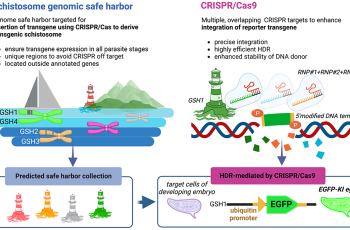
Dr. Brindley and his collaborator’s recent paper was published in Nature Communications: “Heritable transgenic schistosomes as a living platform for SARS‑CoV‑2 neutralizing antibody secretion”

CRISPR‑engineered schistosomes secrete anti–SARS‑CoV‑2 C5‑Fc nanobodies. When released into the blood of infected mice, these nanobodies neutralized SARS‑CoV‑2 virions as effectively as – or more effectively than – national reference human convalescent serum. With existing controlled human infection models for schistosomes and other helminths, these findings support developing transgenic helminths as single‑dose delivery vehicles for therapeutic proteins.

A heritable CRISPR knock-in in Schistosoma mansoni, a human blood fluke, generated a transgenic line that secreted a functional anti–SARS-CoV-2 antibody into the bloodstream of infected mice. Antibodies in the mice’s sera neutralized the virus, demonstrating the potential of engineered schistosomes as living platforms for delivering biologic medicines in vivo. 

This reproducible method for generating transgenic schistosome lines will enable more rapid investigation of fundamental questions, including how these parasites recognize their hosts and locate their preferred sites within them. It may also advance translational research into the development of helminths as drug-delivery systems.


Latest News

Dr. Michael I. Bukrinsky, a Professor in GW's Department of Microbiology, Immunology, and Tropical Medicine, has co-authored a new review titled "Maladaptive trained immunity in viral infections" that was published in the Journal of Clinical Investigation (JCI).
Congratulations to Paprika Berry, Pedro Gazzinelli and Jada Covington (a PhD student in the IBS program - former rotating student) from the Gazzinelli lab, for advancing to the Top 5 in the GW New Venture Competition in the Healthcare track! Their innovative project, Weigh2Dose, also earned them…
Researchers at the George Washington University (GW) School of Medicine and Health Sciences (SMHS), in collaboration with colleagues in France and Germany, have developed a model organism from a genetically modified parasitic worm to better study neglected tropical disease.